Thursday, August 3, 2017

2017 SAP for Utilities Conference topics: FERC and C4C


At next month's 2017 SAP for Utilities conference, HPC America will discuss two topics of considerable interest to utility customers:

Real-Time FERC on SAP S/4HANA. Utilities have a number of options for regulatory accounting on S/4HANA. The delivered solution still relies on the legacy FI-RRU (a.k.a., the "FERC module") which uses a derivation-based model to generate regulatory data in batches at period-end. In contrast, S/4HANA is ideally suited to a transaction-based ("real-time") FERC model with line-item granularity. It doesn't, however, deliver such a design out-of-the-box. (Request our FAQ for more info.) At the conference, you can learn from HPC America's 20+ years of subject matter expertise how your utility can realize transaction-based FERC on S/4 either through configuration and/or code block changes, or with our latest add-on solution, HPC DECIPHER, which runs natively on S/4HANA and delivers the most comprehensive functionality for real-time translation, allocations, adjustments, cost flow forensics, and more. Before the conference, you can request our FAQ about FERC on S/4HANA.

SAP Hybris Cloud for Customer. We're currently leading the first Cloud for Service deployment at a utility company in the United States, and will share our SAP C4C implementation and integration experience with conference attendees. SAP C4C is incredibly important for a number of reasons, not the least of which is the replacement of transaction CIC0 Customer Interaction Center (CIC) in the legacy IS-U/CCS with the C4C Utilities Contact Center (UCC) connected to the IS-U in the ERP. See a live demo of our system at the conference, and learn from the technical challenges we've surmounted by working closely with SAP Support.

To schedule a meeting with HPC at the 2017 SAP for Utilities conference, please contact us directly.

Monday, July 31, 2017

One SAP Roadmap for Utilities: Wrap SAP Cloud Around On-Prem SAP Financials

Recently we were talking with one of our utility company clients about their SAP roadmap, and how utilities can leverage the latest SAP Cloud-based solutions while maintaining their robust and well-design SAP Financials core.

Our guidance for utilities considering such a direction is to initially wrap Software-as-a-Service (SaaS) solutions around the SAP Financials they already have in place. Integrating third-party or SAP SaaS offerings with SAP Financials will be faster and less costly than a total overhaul, and SAP has great middleware in Hana Cloud Integration (HCI) that runs on the SAP Cloud Platform.

Under this kind of model, a SaaS billing solution, for example, would send APIs to the HCI to message SAP Financials for revenue transactions. The HCI would also be used to connect other SaaS offerings to SAP Financials, such as Fieldglass for contractors, Concur for employee expenses, and Success Factors for HR/payroll.

This strategy of integrating SaaS offerings with on-premise Financials has a number of benefits. First, it provides utilities with access to more modern, user-friendly applications that front-office staff and field operations will appreciate. Second, it safeguards regulatory accounting, overheads and allocations, and even the monthly close itself, which are too important to rip and replace without the utmost care. And third, it creates an opportunity in the future to move to a hybrid solution running SAP S/4HANA in the Cloud. Conversion will be more efficient when some front office and field tech functions have already been moved there, and the primary on-prem system remaining is Financials. Then, once S/4HANA is in place, utilities can build-out analytics on the SAP Business Objects Cloud (BOC) as their repository for all reporting from SAP and other non-SAP apps.

Learn more about HPC's implementation services for a terrific SAP SaaS offering, SAP Hybris Cloud for Customer (SAP C4C).

Friday, July 21, 2017

SAP Hybris Cloud for Customer - utility company project update

HPC America's implementation of SAP Hybris Cloud for Customer at a utility company is progressing nicely (read prior posts 1 and 2). We now have the following functionality working in SAP C4C:

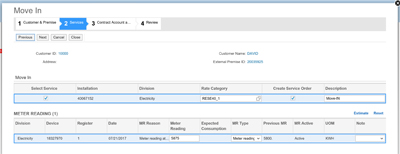
Guided Move-In / Move-Out
This is one of the most important aspects of utility company customer relationship management, and in SAP Hybris Cloud for Customer the functionality steps the end-user through the move-in/move-out process. Initially, there were challenges around meter read estimation and inputs, but we’ve resolved them. We also developed some BADis to streamline the process. For example, out of the box, C4C’s move-in function was creating multiple Service Orders, instead of a single one as the customer required. By modifying the BADi, we've enabled SAP C4C to generate a single Service Order.


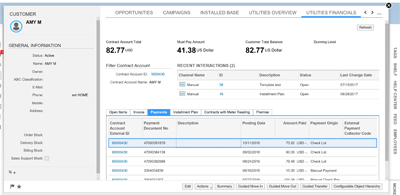
Payment History
Customers’ payment histories were initially not replicated fully in SAP C4C, due to the select query working only on certain ECC payment entry configurations. Our utility customer’s ECC payment input is configured to allow multiple entries, so we worked closely with SAP Technical Support to update Cloud for Customer to meet this requirement.


Editing/Creating Meter Reads
Input of meter reads by contract is now operational in SAP C4C. This update is manual, but the system can also make estimates automatically. If a customer’s account has a smart meter, uploaded readings may be edited or overridden.

Testing of Responsive U/I
We’ve now tested SAP Cloud for Customer's Responsive U/I on various mobile devices, including Apple IOS phones and iPads and Android LG phones. The results are excellent, and the user interface makes for a very rewarding experience. The responsive interface in combination with critical functions, such as manual meter reads in territories without AMI, will provide tremendous benefits. In such a case, for example, field technicians will be able to input meter reads in real-time while at a service address without using any other software by SAP C4C.

Tickets and Customer Interaction groupings
In SAP C4C, the ticket is the main record of all customer interaction. We’ve now configured tickets and work tickets to align with our customer’s “Customer Interaction” groupings, which define categories such as Outage, Disconnects, Payments, Billing, and Service Request. All phone calls and emails between a CSR and a customer will be recorded and linked to the customer account in SAP Cloud for Customer.

To learn more about SAP C4C's benefits for utility companies, please contact HPC America.


Tuesday, July 18, 2017

New White Paper About FERC Reporting Options on SAP S/4HANA

HPC America’s FERC Reporting Option Matrix for SAP S/4HANA outlines three alternative regulatory accounting designs for utilities on SAP. It covers one derivation-based FERC reporting model, and two different transaction-based FERC models. Request your copy now.


This detailed white paper is based on HPC America’s 20+ years of experience developing regulatory accounting solutions for utilities on SAP. It summarizes how three different approaches to FERC accounting function on S/4HANA, including their respective technical requirements, reporting capabilities, and data granularity to support rate case preparation and regulatory inquiries. It also addresses FERC-GAAP reconciliation, financial statement drill-down, FERC adjustments, FERC budgeting, and other topics relevant to utility accounting stakeholders running SAP S/4HANA.

Utility finance, account, rates, and IT professionals may request their copy of the white paper online.

Friday, June 9, 2017

SAP C4C Implementation - Technical Accomplishments to Date

Following up on our recent post about implementing SAP Hybris Cloud for Customer—which as we understand it is the first SAP C4C implementation at a utility company in the United States—we now have several new use cases running:
  • Customer/Contract Account Search
  • Utility Financial view/360 view
  • Create a new contract account in C4C with synchronous update to ECC/CCS
  • Create an installment plan in C4C with synchronous update to ECC/CCS
We have a total of 72 “iFlows” activated in C4C. An iFlow is a set of instructions to map the ECC to C4C, and the other way around, using SOAP messaging. Here’s an illustrative example of an iFlow:


Of these 72 iFlows, 37 are IS-U-specific: they integrate the ECC-CCS billing module to C4C. The HANA Cloud Integration (HCI) middleware has to be tested for each iFlow to determine if the webservice or IDoc is able to get through from sender to receiver. We’re working closely with SAP Support on HCI, URL address assignments, port assignments, and HTTP/HTTPS and SOAMANAGER issues that arise.

We also have 33 “Communication Arrangements” activated in C4C. A Communication Arrangement is a composition of one or more iFlows that collectively complete a business process between the ERP and C4C. They also define the inbound and outbound communication protocols.

We have replicated 150 customers in C4C from ECC. Replication is used to load the master data into the C4C running on an in-memory HANA database on the SAP Cloud Platform (SCP). This enables faster searching and fewer calls to the ECC to reduce I/O traffic on the on-premises ERP.  We will ramp up the number of replications in test once the iFlows are proven to be error-free.

Beyond these technical accomplishments, we start functional testing next week with the utility company’s call center team. After presenting some of the screens for customer searches, bill/balance analysis, and call/task/notification functions, the feedback we’re hearing is that the SAP Cloud for Customer user experience is excellent! The ability to customize screens to the user’s liking is very robust. Based on our experience so far, we expect that the learning curve for C4C will be a lot shorter than it is for CIC0 in classic SAP CCS.

Check back here later this summer for further updates on our SAP C4C implementation at the utility company.

Tuesday, June 6, 2017

SAP Hybris Cloud for Customer (SAP C4C) Implementation at a Utility Company

To serve its water, gas, and electric customers, one of HPC America’s utility company clients had historically utilized decentralized call centers across its service territory. To improve customer service and operational efficiency, the utility designed a new centralized call center responsible for triaging customer inquiries, addressing billing questions, and dispatching support requests to district offices.

To achieve this transformation, HPC recommended SAP Hybris Cloud for Customer (C4C), an SAP SaaS offering that integrates with the SAP Customer Care & Billing (CR&B) utility vertical solution already in production at our client. SAP C4C leverages the SAP HANA Cloud Integration (HCI), a cloud-based middleware between the ECC and C4C running on the SAP Cloud Platform (SCP) platform-as-a-service (PaaS) offering.

We're now working with the utility company to roll out SAP C4C to Customer Service Representatives and district office field planners. SAP C4C will provide a 360-degree financial picture of customer accounts, track customer interactions, and integrate with the utility’s existing telephony software for Interactive Voice Response (IVR).

By utilizing SAP’s cloud solutions, this utility company will not only be able to achieve its customer service objectives but also realize significant cost savings, faster implementation, and greater long-term security.

Monday, June 5, 2017

SAP Business Warehouse Improves Reporting at Utility Company

A regional utility company with SAP ECC and SAP Business Warehouse licenses wanted to extend its reporting capabilities beyond monthly financials for the board. One of the utility’s General Managers recognized that its homegrown network of Microsoft Access databases and Excel spreadsheets was inherently error-prone and resulted in many versions of the truth throughout the organization.

The Customer Accounts Receivable team presented the perfect business case. It relied on disparate data sources and time-consuming manual processes to collect and analyze customers’ account data, causing significant delays to complete monthly reports. A/R reporting also suffered from formula errors and missing information, due to extensive data manipulation outside of the SAP ERP.

Learn how HPC America and the utility company leveraged SAP Business Warehouse to cut A/R reporting time from three weeks to just three hours; eliminated databases and spreadsheets outside the SAP book of record; and improved data integrity and established one version of the truth for A/R reporting. Read the complete utility company case study about SAP BW reporting.